

As demand grows for electric vehicles, batteries, renewable energy systems, and advanced electronics, developing a cleaner and more efficient ways to recover critical materials is becoming increasingly important.
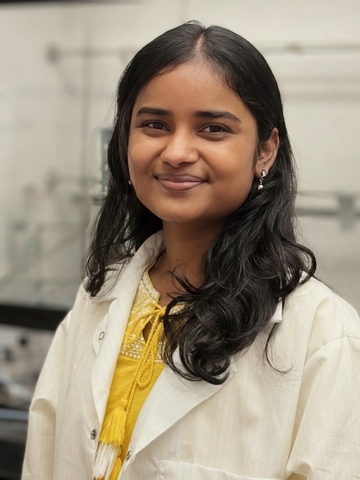
Preethi Arunachalam, a Ph.D. student working with Dr. Zhenmeng Peng, is researching redox-mediated electrodialysis, an electrochemical separation technology that could provide a more sustainable method for extracting and recovering valuable metals. Her work focuses on extending the technology to separate and recover rare earth elements from complex material streams.
Through her research, Arunachalam hopes to reduce chemical consumption, energy use, and secondary waste while contributing to a more circular and resilient supply chain for critical materials.
The possibility of transforming waste into a new source of critical materials is incredibly motivating.
Can you explain your research on redox-mediated electrodialysis and how it is used to extract and recover critical metals?
My research focuses on redox-mediated electrodialysis (rm-ED), an electrochemical separation technology that enables the recovery of valuable critical metals from aqueous solutions. The technology was originally developed for desalination, where an applied electrical potential removes dissolved salt ions from water. Over time, our group recognized that the same approach could be extended beyond water treatment to resource recovery and environmental remediation, including the removal and concentration of nutrients such as ammonium and phosphate from wastewater. These applications demonstrated that electrochemical separation processes can do more than purify water. They can also recover valuable resources that would otherwise be lost.
More recently, rm-ED has emerged as a promising approach for recovering critical materials such as lithium, the process uses a small, applied voltage to drive charged metal ions through ion-exchange membranes, selectively transferring them from a feed solution into a separate product stream where they can be concentrated and collected. The "redox-mediated" component refers to compounds that undergo reversible oxidation and reduction reactions at the electrodes. These reactions facilitate charge transfer throughout the system while minimizing reliance on direct electrode reactions, such as water splitting. As a result, rm-ED has the potential to reduce both chemical consumption and energy requirements compared with conventional extraction and separation technologies.
In my research, I apply rm-ED to the recovery and separation of rare earth elements, which are critical to technologies such as electric vehicles, batteries, renewable energy systems, and advanced electronics. I investigate how factors such as applied voltage, solution chemistry, and ion competition influence metal transport, recovery efficiency, and separation performance. I am also exploring whether rm-ED can selectively transport one rare earth element over another, enabling more efficient separations from complex mixtures. Ultimately, my goal is to develop rm-ED into a sustainable, continous, energy-efficient platform for critical-material recovery that minimizes chemical use, energy consumption, and secondary waste generation.
Why is the recovery and separation of rare earth elements important, and what challenges are you hoping your research can help address?
Rare earth elements are essential to many technologies that we use every day. Neodymium, praseodymium, and dysprosium, for example, are used to produce high-performance permanent magnets found in electric-vehicle motors, wind turbines, electronics, and other advanced energy systems. As the demand for these technologies grows, the demand for rare earth elements is also expected to increase.
Recovering these materials from discarded products, industrial waste, and other secondary sources can reduce dependence on newly mined resources. It can also strengthen domestic supply chains and prevent valuable materials from being lost in landfills or low-value waste streams. However, recovering rare earth elements is only part of the challenge - they must also be separated from one another before they can be reused. This separation is particularly difficult because rare earth elements have very similar ionic sizes and chemical properties and are usually found together. Conventional techniques, such as solvent extraction and chemical precipitation, can achieve high-purity products, but they often require numerous separation stages and substantial quantities of acids, bases, and organic solvents. These processes can be chemically intensive, energy-demanding, and capable of generating significant secondary waste.
My research investigates rm-ED as an electrically driven, water-based alternative. Compared with conventional methods, rm-ED can reduce the need for organic solvents and repeated chemical additions, operate at relatively low applied voltages, and combine metal transport and concentration within one membrane-based system. Its flow-based design also makes continuous operation possible. When rm-ED is paired with a sufficiently selective membrane or separation material, the system can continuously direct a target ion into a high-purity product stream. This capability has been demonstrated for some critical metals, but achieving similarly high-purity separation among closely related rare earth elements remains an important challenge.
My work therefore examines how rm-ED can be optimized for rare earth recovery and how its selectivity can be improved while maintaining the advantages of continuous operation, lower chemical consumption, and reduced waste generation.
What interested you in this area of research, and what impact do you hope your work will have on the future of batteries and critical-material recovery?
I became interested in this research because it brings together electrochemistry, membrane science, and environmental sustainability to address an important real-world challenge. Critical materials are essential to clean-energy technologies, yet their extraction and processing can have significant environmental consequences and create supply-chain concerns. This research gives me an exciting opportunity to explore how these valuable materials can be recovered more efficiently, reused, and kept in circulation rather than discarded.
What fascinates me most about rm-ED is that electricity provides the driving force for separation. By adjusting operating conditions such as voltage, flow rate, pH, and solution composition, I can investigate how metal ions move through the system. The work is also very hands-on: I assemble the cell, position the membranes, connect the tubing and pumps, prepare the solutions, and monitor the system throughout each experiment. Seeing a cell that I assembled successfully transport and recover valuable metals is incredibly rewarding - it feels like watching fundamental electrochemistry develop into a practical separation technology.
Of course, laboratory research naturally requires patience, persistence, and creative problem-solving. A membrane may not perform as expected, the flow may become unstable, or certain conditions may cause a metal to precipitate instead of passing through the membrane. Although troubleshooting can be challenging, it is also one of the most interesting and rewarding parts of research. Every experiment-whether or not it works exactly as planned-teaches me something new about the system and helps me improve its design, performance, and selectivity.
My advisor, Dr. Zhenmeng Peng, has honestly been a lifesaver throughout my research journey. He has been a constant source of guidance, encouragement, and motivation. His support helps me approach setbacks as opportunities to learn and think more deeply about the problem. I know that I cannot solve every challenge in critical-material recovery by myself, but I hope to make a meaningful contribution toward solving one part of this much larger problem. Each day in the laboratory brings a new question, a new challenge, or a new idea to explore, and that sense of discovery is what makes research so exciting to me.
Ultimately, I hope my work contributes to a more circular approach to critical materials, in which valuable metals are recovered from used products and industrial waste streams and returned to the supply chain. The possibility of transforming waste into a new source of critical materials is incredibly motivating. I hope rm-ED can help make metal recovery more continuous, efficient, and environmentally responsible while supporting the cleaner, more resilient material systems needed for our energy future.
Connect with Preethi Arunachalam on LinkedIn.