
Our Research
Point-of-care diagnostics for resource-limited settings
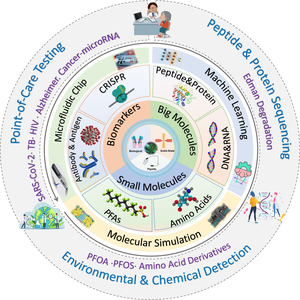
Nanopores are capable of ultrasensitive quantitation of single proteins/peptides, and thus permit monitoring of low-abundance circulating biomarkers. The goal of this project is to develop a portable in vitro diagnostics assay using Nanopore technology for rapid diagnosis and treatment monitoring of infectious diseases (e.g. Tuberculosis, HIV) in resource-limited and high-burden areas. For future clinical translation, we are working with clinicians to validate the assay’s performance on (1) detection of active Tuberculosis; and (2) risk assessment of HIV maternal-fetal transmission.
Translational biomarkers and biosensors to enable personalized medicine
Most cell types abundantly secrete extracellular vesicles (EVs), including tumor cells that usually show increased EV secretion levels. Similar to cells, EVs are composed of a lipid bilayer and can contain all the molecular components of a cell, such as proteins, lipids, RNA and DNA fragments that reflect the phenotypic state of their cell of origin. These biomolecules are excellent candidates for diagnostic and prognostic biomarkers. Our work has been focused on isolation of circulating EVs using nanomaterials and microfluidics based technologies, and identification of novel proteomics/genomics biomarkers inside them to enable early detection and personalized treatment regimens for cancer patients.
Nanostructure-based tools for fundamental biochemical studies
Generic biosensing platforms for fundamental biochemical studies can inform medical and pharmaceutical research. We are developing nanostructure-based localized surface plasmon resonance (LSPR) biosensors to study biomolecule interactions. Nanostructures covered with lipid bilayers can mimic bacteria/cell membranes, possess similar two-dimensional fluidity, and be readily engineered to contain specific lipids and proteins. LSPR signal from such nanostructures can indicate the binding kinetics of biomolecules and lipid bilayers, with potential applications for drug development and drug-resistance studies.
Featured Work