


The EOL Lab has pioneered research in MHz-frequency power conversion, digital twin technology for microgrids, and AI-integrated power electronics design. Its technical contributions push the boundaries of what is possible in power electronics hardware and control systems.
Ultra-High-Frequency Power Conversion
The EOL lab led the development and experimental demonstration of a 1MHz, 5kW isolated resonant converter – one of the highest-frequency, high-power converters reported to date. This achievement required overcoming significant challenges in electromagnetic interference and magnetics design at MHz frequencies. The resulting converter not only surpasses prior literature benchmarks but also provides new insights into the design of compact, high-density power converters. One journal manuscript on a similar 1-MHz, 1-kW buck converter work has been accepted, alongside multiple conference papers and even a provisional patent in process, underscoring the novelty and value of this contribution. The converter has a peak efficiency of 97.2% and a power density of 27.2 W/cm³ including non-optimized convective thermal system. Weighing less than 1 kg, it has potential for electrified transportation applications.

1-MHz, 1-kW LLC resonant converter hardware.
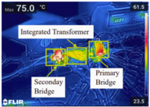
1-MHz, 1-kW LLC resonant converter thermal image at full load.

1-MHz, 1-kW LLC resonant converter experimental waveforms at full load.
Digital Twins for Power Electronics and Microgrids
The EOL lab has pioneered in applying digital twin technology to power electronics and energy systems. She has developed a digital twin-based forecasting framework for DC microgrids that can predict and manage power flow in real time. Notably, this work was published in Nature’s Scientific Reports in 2025 – a testament to its high impact and broad significance. In parallel, EOL introduced a query-and-response digital twin architecture for transportation electrification systems, published in IEEE Transactions on Transportation Electrification. This framework uses a multidomain, multi-fidelity “image folio” of system models to respond to queries about system state and health, enabling proactive management of complex power systems such as electric microgrids. These contributions are laying the groundwork for smarter, more resilient microgrids that can anticipate and adapt to changes (e.g., pulsed loads or faults) autonomously.
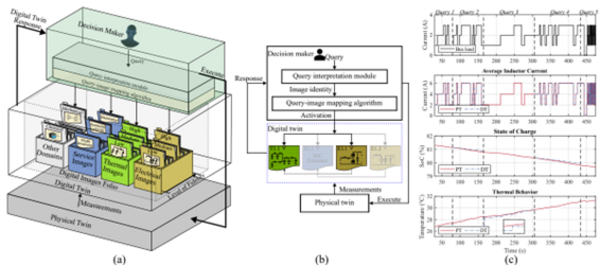
An image-based digital twin for improved response times between query and execution of instructions.
Advanced Control Algorithms and AI Integration
Through Office of Naval Research (ONR)-funded projects, EOL has invented new control methods to improve microgrid resiliency. For example, conventional droop control algorithm was extended to an “Extended Droop Control” for handling pulsed loads in an n-converter DC microgrid, with seamless reversion to resistive droop control when the pulses are inactive. This work, validated experimentally, enhances system stability and has been implemented in a hierarchical digital twin testbed for more complex systems. Moreover, their research emphasizes AI-integrated power electronics design – using machine learning and data-driven techniques in converter control and design optimization. The lab's long-term vision of just-in-time decision making for converters highlights their ability to fuse AI with power electronics to achieve unprecedented levels of performance and reliability.
Electrified Transportation and Digital Shadows
In a NASA-funded project, the EOL lab developed a digital shadow for electric vertical takeoff and landing (eVTOL) powertrains, aimed at monitoring the remaining useful life of critical components. Within a one-year project timeframe, EOL delivered a functional framework that can track health indicators of an eVTOL’s power electronics and drive components in real time. This breakthrough provides a foundation for prognostics and health management in electrified aircraft – a key to ensuring safety and reliability in emerging electric aviation. Even after the project’s completion in 2023, the lab has continued to disseminate the results, with multiple conference papers and follow-on research proposals stemming from this effort.